
Home
How I designed a product that reduces emotional friction where it matters most
Product site — askbefore.eu
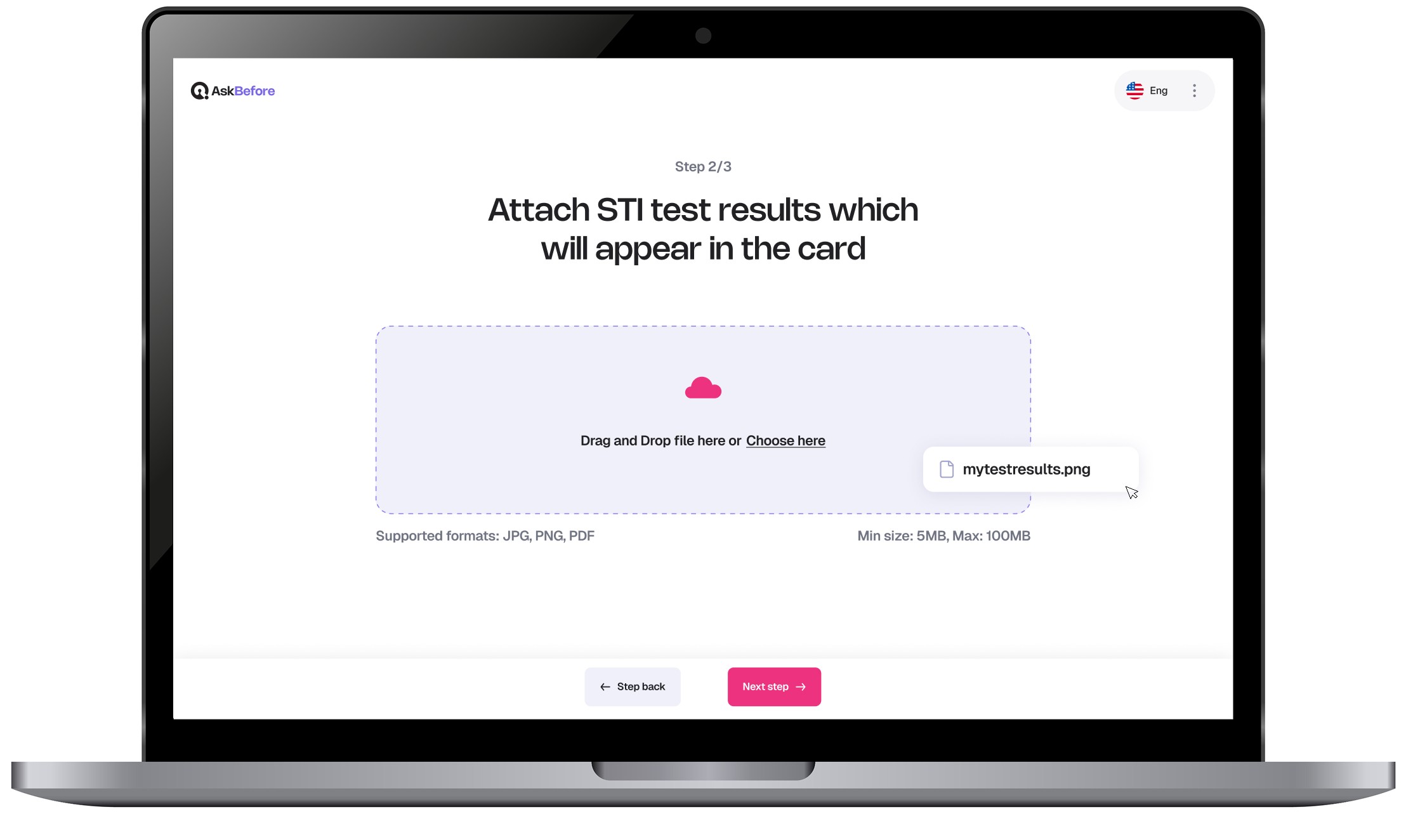
What’s built
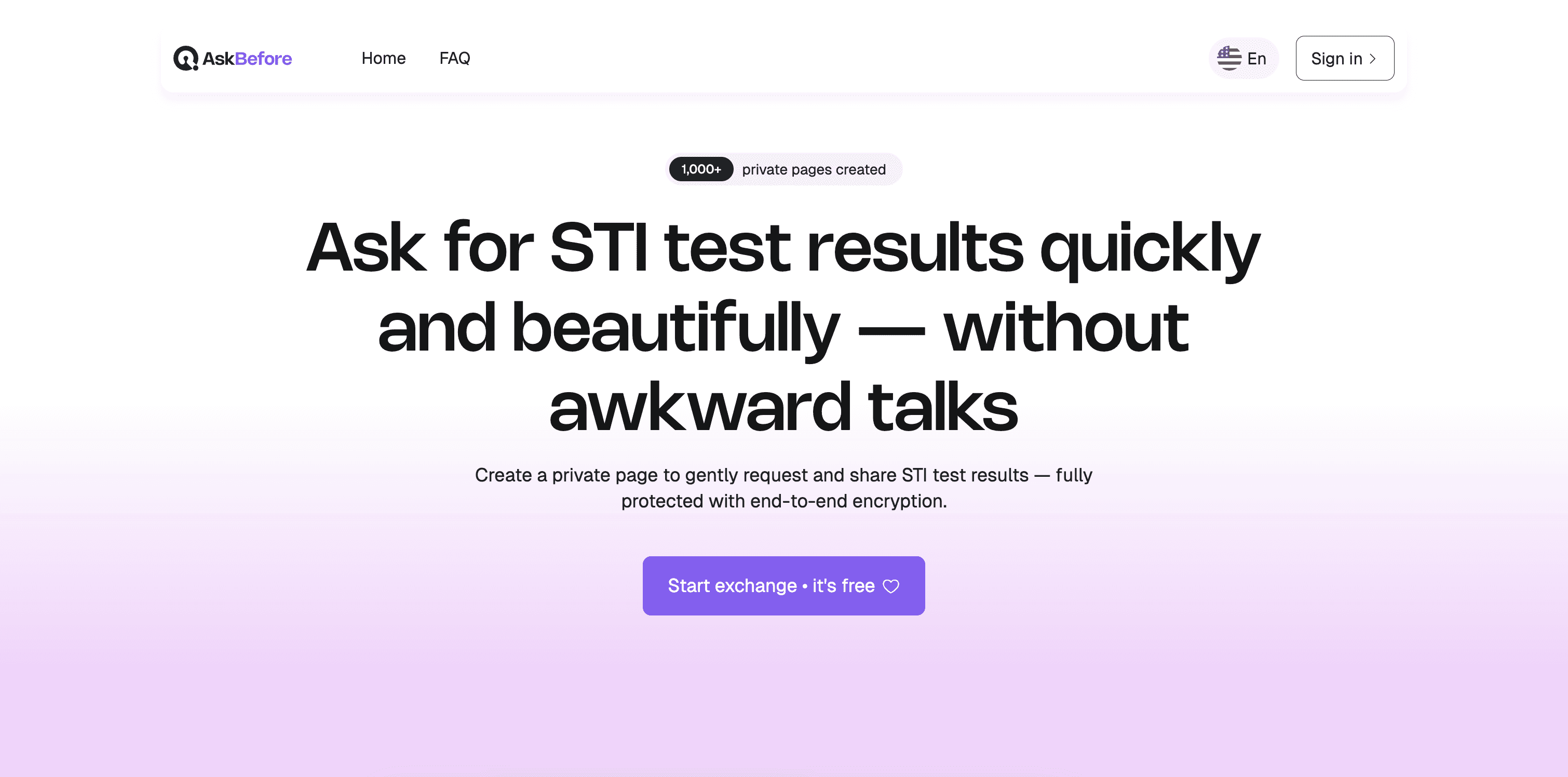
I led and launched AskBefore, a product that helps people request and exchange STI test results without damaging the emotional context of early relationships.
At the beginning of a relationship, caring about sexual health often clashes with the fear of being misunderstood.
AskBefore resolves this tension by turning an awkward, emotionally charged moment into a clear, safe, and respectful process.
The product is a two-sided platform:
for users, it reduces emotional friction and protects privacy
for clinics, it provides a secure and legally sound interaction layer
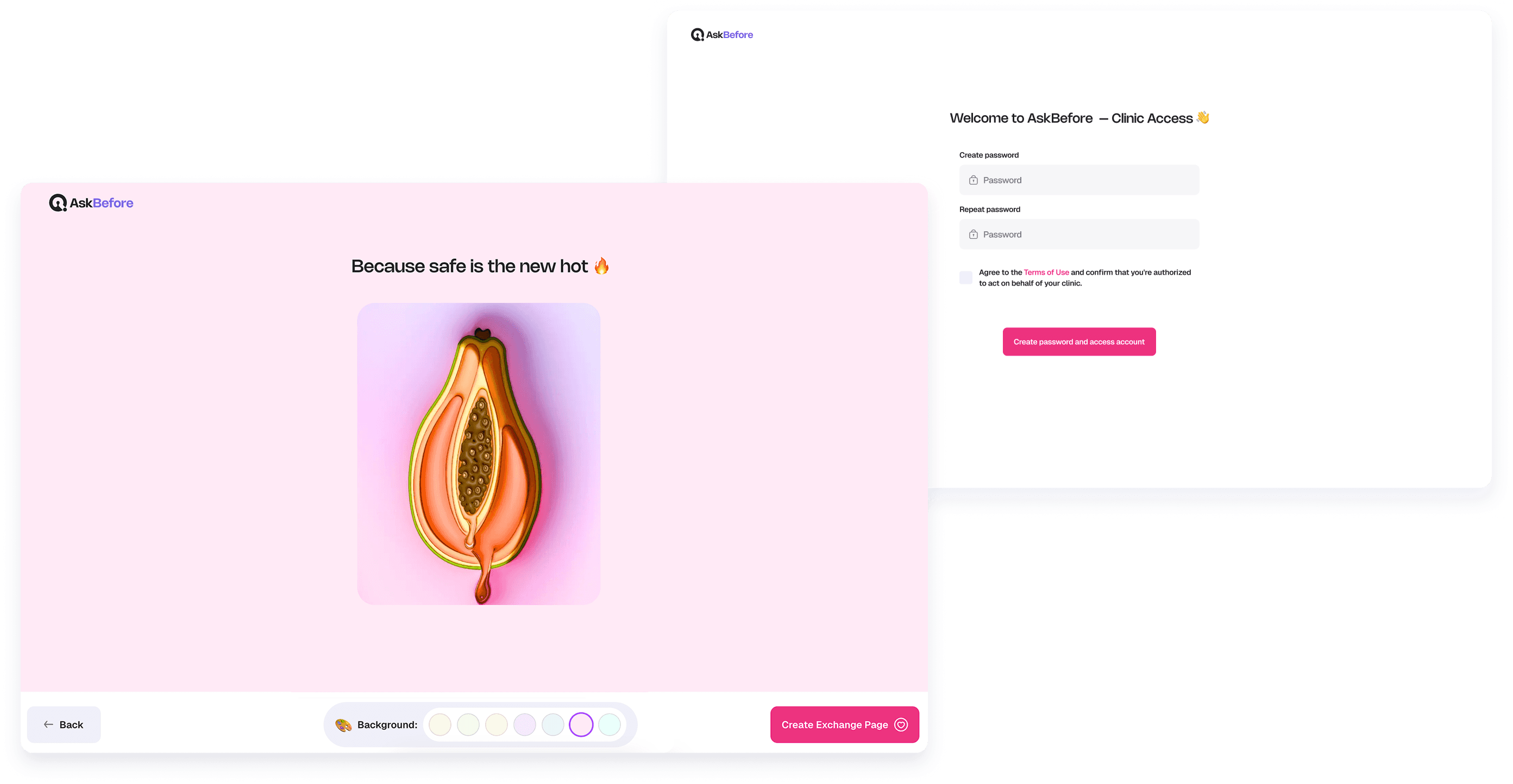
My goal was not to design an interface, but to build a system that supports people in a vulnerable moment while remaining scalable as a product
How it’s built
Discovery and product insights
I started with qualitative discovery. Together with a designer, Maria, we conducted interviews with 20+ people who had already exchanged test results or were planning to do so.
As a result of the study, it became clear:
1️⃣ People exchanged certificates via Telegram and WhatsApp — not because it was convenient, but because asynchronicity reduces awkwardness.
2️⃣ Everyone tried to “decorate” the message: adding emojis, jokes, and a soft tone.
3️⃣ Hearts, smiley faces, bananas, and other playful elements helped shift the perception from anxious to romantic.
But these solutions failed to deliver the most important thing.
Why messengers are not the solution
We identified several critical problems:
🛑 any chat allows a certificate to be forwarded to a third party, and the sender will never know
🛑 most popular messengers do not provide full end-to-end encryption for such scenarios — the certificate may potentially be accessible to third parties
🛑 over time, the very fact of the exchange becomes compromising: messages can be scrolled back, screenshotted, and used against a person
🛑 in small towns and communities this is especially painful — reputation is fragile
🛑 despite asynchronicity, people still had to choose their words carefully and guess the right moment: “When should I ask?” and “How should I phrase it?”
I realized that what was needed here wasn’t another channel — it was a product. And that product became AskBefore.
Who I was really designing for
1) On one side — people who care about their health and are aware of the risks.
Often, these are people with past negative experiences or a higher level of awareness — shaped by media and influencers.
2) On the other side — clinics.
For them, a certificate is not just a document, but a matter of brand, trust, and legal responsibility.
The clinic makes the decision to participate in the product, while an administrator configures pricing, locations, and availability.
From the very beginning, I understood that the product had to work for both sides, without shifting risks onto either of them.
Key product decision
I made a fundamental decision:
AskBefore is not a “verification” service, but a space of care.
🎯
The goal of the product is not to prove something to a partner.
The goal is to make a difficult conversation emotionally easier.
We designed a digital process for requesting and exchanging certificates that:
1️⃣ reduces embarrassment
2️⃣ sets clear and appropriate expectations
3️⃣ supports trust
4️⃣ works as prevention rather than a reaction to fear
The certificate stops being an argument. It becomes a gesture.
For many men, testing for intimate STIs can feel especially exposing — sometimes even like a heroic act.
🐉🤺
Modern heroes don’t slay dragons.
They get tested for the peace of mind of their partner.
AI as an amplifier, not a threat
I saw AI not as a “trendy layer,” but as a tool to increase the product’s value.
At first, I thought about generating romantic messages inside the product.
But I quickly realized: my idea of the “right words” is limited.
So I decided to hand that task over to AI.
As a result, users got:
— an endless number of unique phrasings
— texts adapted to their context, tone, and intent
— the feeling that the request truly sounded like their own words
AI was used in a very targeted way:
— with no access to personal data
— with no transfer of medical information
— only where it genuinely improved the experience
I was looking for a balance between:
— growth of the key metric
— technical complexity
— safety
In AskBefore, AI isn’t a showpiece — it’s a careful product amplifier.
Insights that shaped the product
During testing of the first MVP, it became clear that:
1️⃣ a strict medical tone increases anxiety
2️⃣ excessive information overwhelms users
3️⃣ tone and context matter more than the amount of data
That’s why design, copywriting, and the sequence of steps became a product decision — not just a visual one.
Minimal flow as a strategy
I deliberately designed the process of creating an exchange page so that:
— there were only three mandatory steps
— everything else was optional — for emotional tuning
This was not simplification for the sake of speed.
It was a decision aimed at reducing time-to-value and cognitive load.
One of the key product moments was a warning that the certificate is valid only at the moment the tests are taken.
This decision simultaneously:
— reduced clinics’ fears
— managed user expectations
— removed legal ambiguity
It was an example of how a product solves a systemic problem, not an interface-level one
Why it works
How I defined product success
Before launch, I defined the key goal of the product —
successfully completed exchange pages.
This became the North Star Metric because:
— it reflects real value for users
— it shows that the emotional barrier was overcome
— it is directly tied to clinics’ trust
Around it, I built a system of metrics:
— started and completed pages
— step-by-step drop-off
— time to first action
— repeat requests
— user retention
But qualitative signals were no less important:
— did it become easier to ask?
— did the awkwardness decrease?
— did users feel care rather than control?
For me, the success of AskBefore is not just about product usage,
but about the feeling that it was appropriate in the moment.
My role: more than design
I acted as a founder and product owner, fully owning the product end-to-end.
I:
— shaped the vision and positioning
— set product and design principles
— built the user flow and information architecture
— defined what data we would not collect — even if it made development easier
— worked directly with engineering, aligning UX implementation with GDPR and technical constraints
— shipped changes myself using no-code tools
— presented the product to clinics and intermediaries, gathering early feedback
Development iterations did take place. The product went through an MVP stage, during which user, medical, legal, and other compliance reviews were conducted, and was then transitioned into an MLP version. The product continues to evolve and expand.
200% increase in development speed, 50% reduction in time to market, 75% decrease in integration time.
Case study